The One Thing All Female Leaders Do to Achieve Success
Updated: Jun 1, 2025

When was the last time you took a nice long look at your expenses and what is coming into your account each month, and what is going out?
For many women, creating a budget and a financial plan can be a stressful task.
If you’ve never built a budget before or simply can’t stick to one, you’re not alone. According to a recent study by Fidelity, while 60% of women worry they won’t have enough money to last through retirement, only one in three Americans have a detailed budget. We’re all stressed about money, but the key to being successful is to stop stressing and start planning.
Instead of thinking of a budget as this horrible task you have to do, start thinking about it as a way to plan for the future you want to have. In other words, think about what your goals are, and how you can work toward them with what you have. We’ve drawn on leading financial expert, Sallie Krawcheck, the former Wall Street powerhouse who founded Ellevest — an investment firm aimed at women, to get her jargon-free, tips on how to create a budget and achieve your goals.
If you’ve been putting off budgeting and creating a financial plan to achieve your goals, it’s time to finally check it off your to-do list.
Here’s a look at how to develop a budget and a financial plan that will help you take control of your money.
Step 1: Do An Audit of Your Expenses
Krawcheck says, and you’ll be set on the path to financial success over the course of your life.
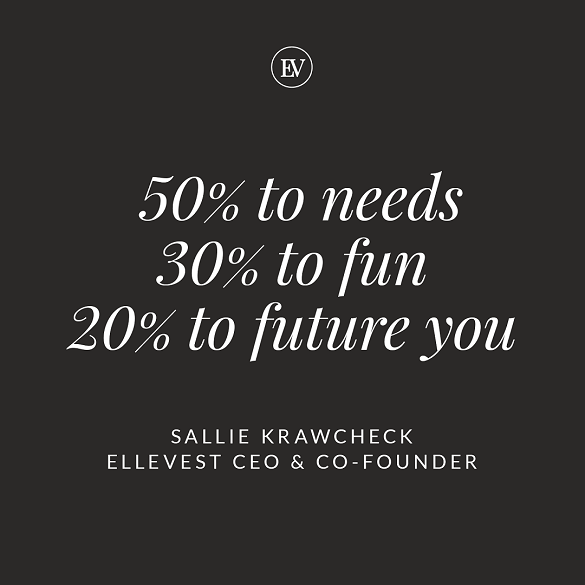
“And if you can’t hit that 20 percent goal right away, that’s okay,” Krawcheck
Step 2: Contribute to Your 401(k)
Before you say, “I’m too young to think about retirement,” let me remind you of that dream to live in Paris or take an African safari — whatever your deal is — that’s your retirement dream. Now you can make it a goal and plan for it. How?

The more you can automate these things, the better off you are. It’s easy to dip into your savings account when it’s just money sitting there. But when you open an investment account and put 20 percent (or whatever you can) every month toward your goals, you’ll feel in charge of your money and will be less likely to overspend.
Try it now: Have questions about rolling over your 401 (k)? The entourage at Ellevest can help guide you. It just takes 10 minutes. Find out more here.
Step 3: Contribute to Your IRA
“You know you want to retire in style. And you deserve a retirement account designed to help you do just that,” says Krawcheck. “Every dollar that you contribute to an Individual Retirement Account — aka, an IRA — is a dollar off your taxable income.”
Anyone with earned income can open an IRA. That’s great news, especially if you’re a freelancer, or work at a place without a 401(k) plan. Once you open an IRA, it stays in the same place, even when you switch jobs; it’s not housed with your employer. Pretty cool, right?
Here are the basics: There are two types of IRAs — Traditional and Roth. What’s the difference? With a Roth IRA, you pay taxes on the amount you contribute first. This means you don’t reduce your current tax liability, but once you pay those taxes, you don’t have to pay them again, meaning you’re not paying taxes on the growth of your investments. When you make withdrawals, every last penny is yours to keep.
Anyone can contribute to a Traditional IRA, eligibility for a Roth IRA is based on your income level. You can see which one’s right for you here. Whether you open a Traditional or Roth account, the bottom line is an IRA lets you add thousands of dollars a year to your retirement savings. You can open an IRA at Ellevest, or at another financial services provider.
Try it now: Have questions about rolling opening your IRA? The entourage
at Ellevest can help guide you. It just takes 10 minutes. Find out more here.
Step 4: Start Other Investments
“When it comes to getting things done, there’s nothing quite like having a plan,” says Krawcheck.
Seriously — there was a study in the British Journal of Health Psychology that showed a strong correlation between writing down a goal and following through with it. The biggest problem for most of us is without clearly identified goals and a financial plan to back it, we have a tendency to mismanage our money with overspending. So, the key here is to set goals for yourself.
Every journey starts with a destination, and you’ll feel so good and so confident once you set these goals and establish a budget to achieve them.

Try it now: Have questions about investing? Get a personalized financial plan from Elllevest in just 15 minutes and have expert advice at your fingertips.
Have goals you want to budget for? Whether your goal is to develop that budget, buy a home, have kids, or take that big trip, Ellevest can help guide you toward achieving your goals.


